
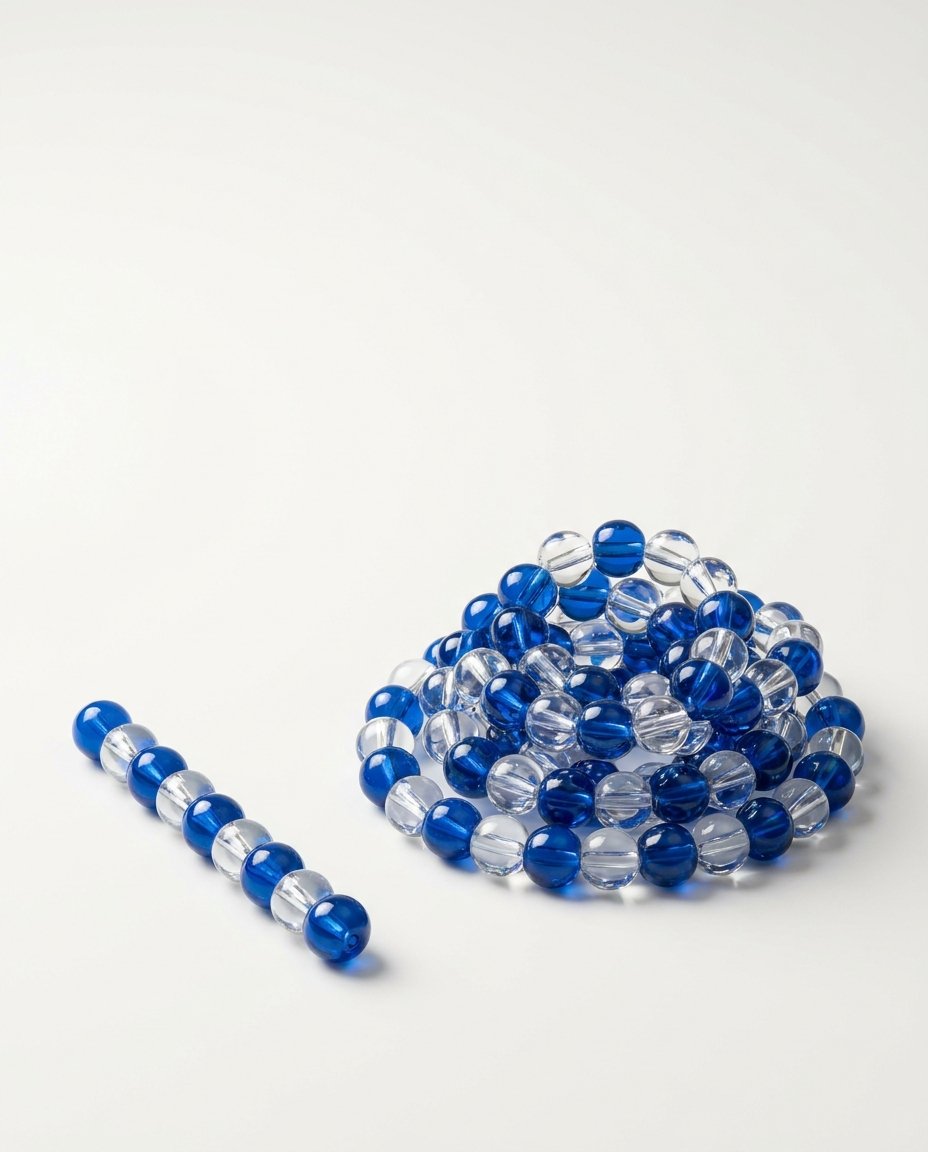
A peptide is a short chain of amino acids, the building blocks of proteins[1, 2]. Under US regulations, a chain of more than 40 amino acids counts as a protein[3]. Peptides are the shorter chains. The line between a peptide and a protein is a matter of length.
Key points
- A peptide is a series of well-ordered amino acids, usually small in mass[1].
- Proteins are made up of hundreds or thousands of amino acids[2].
- US regulations count a chain of more than 40 amino acids as a protein[3].
- GHK is a peptide of just three amino acids[4].
What is a peptide made of?
Every peptide is built from amino acids. An amino acid is a small unit, and the units are joined one after another into a chain. A peptide is that chain when it is short.
One review defines a peptide as a series of well-ordered amino acids, usually with molecular weights of 500 to 5000 daltons[1]. A dalton is a unit of mass used for molecules. The words well-ordered mean the amino acids sit in a fixed sequence, one after the next, and are not a loose heap[1].
That is the whole idea. A peptide is a chain, and the links are amino acids.
What is a protein, and how is it different?
A protein is made of the same kind of units, in far greater numbers. MedlinePlus Genetics, a service of the US National Library of Medicine, says proteins are made up of hundreds or thousands of smaller units called amino acids[2]. It also says there are 20 different types of amino acids that can be combined to make a protein[2].
So the two words describe the same kind of chain at different lengths. A peptide is the short version[1, 2]. A protein is the long version[2].
Where is the line between a peptide and a protein?
Chemistry offers no single stopping point in the sources we read, but US federal regulation does draw a line. The definition of a protein in 21 CFR 600.3(h)(6) says a protein is greater than 40 amino acids in size[3]. The FDA restated that definition in a final rule published in the Federal Register on 21 February 2020[3].
Read the rule carefully. It says a chain of more than 40 amino acids counts as a protein[3]. That is a legal definition, written for US regulation, and it sets where the law places the label[3].
Here’s what we think: the line between a peptide and a protein is a matter of length. Short chain, small word.
How small can a peptide be?
Very small. A review of the compound GHK-Cu, whose lead author works at Skin Biology, a company whose business is the compound, calls GHK a tri-peptide, a chain of three amino acids named glycyl-L-histidyl-L-lysine[4]. The tri in tri-peptide is a count of three[4].
Three amino acids is far below the 40 amino acid line, and far below the hundreds or thousands that make a protein[2, 3, 4]. That is why GHK-Cu is just three. The same word, peptide, covers a chain of three and a chain much longer, as long as the chain stays short next to a protein[1, 4].
How common are peptide medicines?
More common than the word suggests. The same review that defines a peptide reports the approval of more than 80 peptide drugs worldwide, and more than 170 in active clinical development as of 2022[1]. Note the word worldwide. That count is not a count of FDA approvals, and this page does not treat it as one[1].
The review also describes insulin as the first therapeutic peptide, and it dates the solid-phase synthesis technology developed by Merrifield to 1963[1]. Both facts show that peptides are an old subject in chemistry and medicine, not a new fashion[1].
What does this page not say?
This page defines a word. It does not say what any peptide does in a body, and it gives no amount or use for any peptide. It does not say any compound is approved or safe. Those are separate questions, and each needs its own sources.
If you are reading about a compound, ask first how many amino acids it has and what the source for that number is[1, 3]. A short chain with a clear count is a peptide. A long chain is a protein.
Peptide-Y reads the studies. Our peptides are in our catalogue for research.
For research and laboratory use only.
Questions
What is a peptide in simple words?
A peptide is a short chain of amino acids, the building blocks of proteins[1, 2].
How many amino acids make a protein?
Under US regulations, a chain of more than 40 amino acids counts as a protein[3]. MedlinePlus Genetics describes proteins as made up of hundreds or thousands of amino acids[2].
Is GHK-Cu a peptide?
A review calls GHK a tri-peptide, a chain of three amino acids[4].
Sources
- Wang L et al., Therapeutic peptides: current applications and future directions, Signal Transduction and Targeted Therapy, 2022. PubMed
- MedlinePlus Genetics (US National Library of Medicine), What are proteins and what do they do?, medlineplus.gov. medlineplus.gov
- US Food and Drug Administration, Definition of the Term “Biological Product” final rule (Federal Register document 2020-03505, 21 February 2020), restating 21 CFR 600.3(h)(6). govinfo.gov (PDF)
- Pickart L et al., Regenerative and Protective Actions of the GHK-Cu Peptide in the Light of the New Gene Data, International Journal of Molecular Sciences, 2018. PubMed